
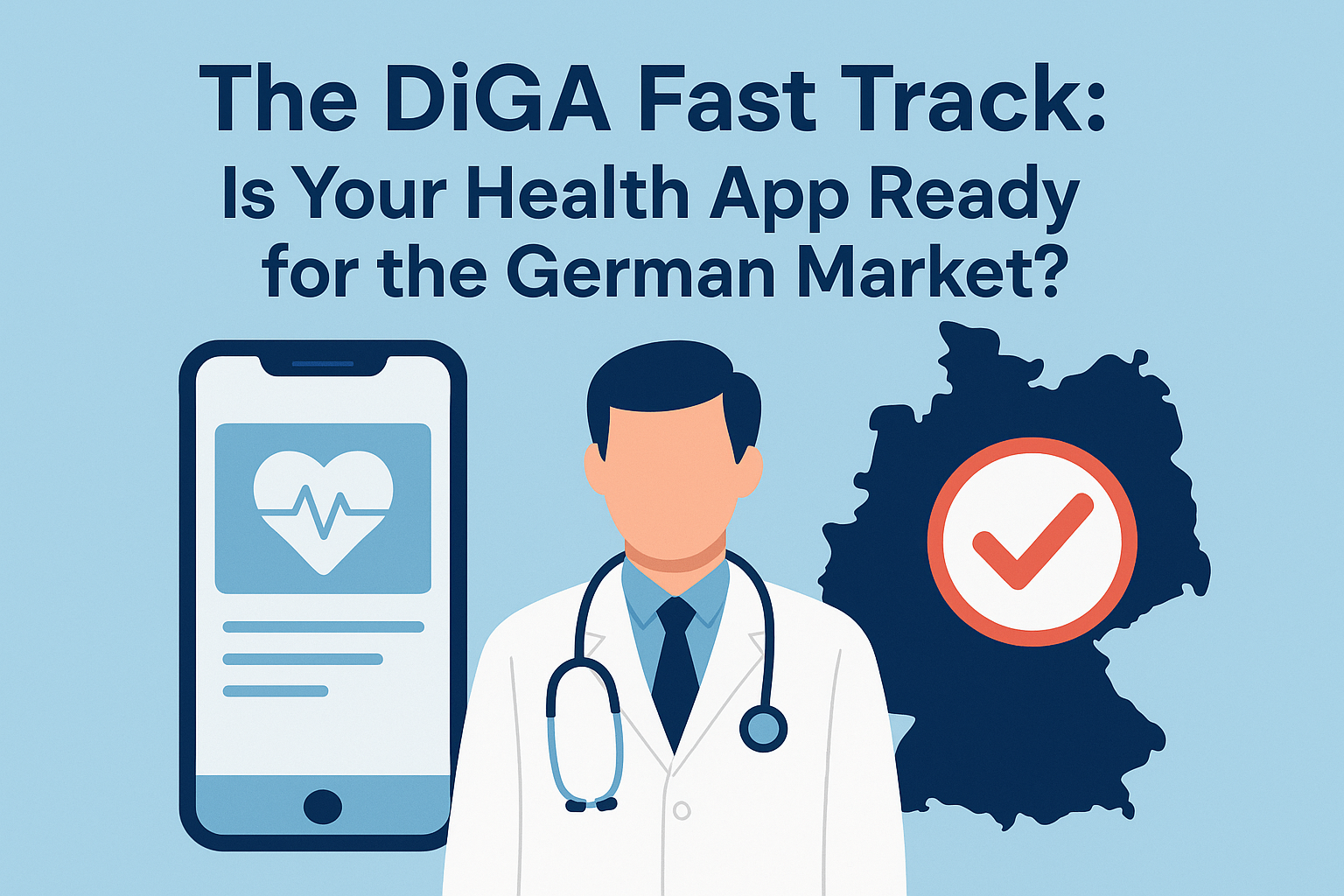
Imagine a healthcare market where doctors don’t just recommend your digital health app—they formally prescribe it. Imagine a system where your app is not just a wellness tool, but a reimbursed, integrated part of patient care, accessible to over 73 million people.
This isn’t a future vision; it’s the current reality in Germany.
Thanks to the groundbreaking Digital Healthcare Act (DVG), Germany has created a revolutionary pathway for digital health solutions called DiGA (Digitale Gesundheitsanwendungen). It’s a structured, world-leading framework that allows quality-assured health apps to be prescribed and paid for by the national health system.
For MedTech founders, the DiGA pathway is the single greatest opportunity to enter and scale within the EU. The process, however, is as rigorous as the opportunity is vast. This guide will break down the DiGA Fast-Track process, outline the core requirements, and help you assess if your app is truly ready for the German market.
What Exactly is a DiGA?
Think of a DiGA as a “digital medicine.” It’s a CE-marked medical device (risk class I or IIa) whose primary function is powered by digital technology. These are not simple wellness trackers; they are sophisticated software applications designed to support patients and clinicians in the diagnosis, treatment, and management of a disease or injury.
The Power of Prescription
This is the game-changer. Once an app is successfully listed in the official DiGA Directory, it can be prescribed by any doctor or psychotherapist in Germany. The cost is then reimbursed by the patient’s statutory health insurance fund. This model effectively solves two of the biggest hurdles for any health app:
- Credibility & Distribution: A doctor’s prescription provides the ultimate seal of approval and a direct channel to patients.
- Monetization: It creates a clear and reliable revenue stream, removing the need for direct-to-consumer payments.
Examples of successful DiGA categories include apps that provide cognitive behavioral therapy for depression, guidance for managing tinnitus, and digital physical therapy programs for back pain.
The DiGA Fast-Track: Your Pathway to the German Market
The pathway to becoming a DiGA is a structured process overseen by Germany’s Federal Institute for Drugs and Medical Devices (BfArM). The “Fast-Track” is designed to get innovative and safe applications to patients quickly, typically within a few months of application.
The process has two main stages:
Stage 1: Provisional Listing (The First 12 Months)
Your app can be listed in the DiGA Directory on a provisional basis if you meet all the fundamental requirements (which we’ll cover below) and provide plausible evidence that your app creates a “positive healthcare effect.” During this trial year, your app is fully prescribable and reimbursable. This period is your opportunity to conduct a formal clinical trial to generate the robust data needed for permanent listing.
Stage 2: Permanent Listing
After successfully proving your app’s positive healthcare effect with data from your trial, you can apply for permanent listing in the DiGA Directory. This secures your app’s place in the German healthcare system for the long term.
Are You Ready? The 5 Core Requirements for DiGA Approval
BfArM evaluates every application against a strict set of criteria. Success depends on delivering a comprehensive package of evidence. Here is a checklist of the five core requirements.
1. Safety, Functionality, and Quality
This is the baseline. Your app must be a CE-marked medical device (falling into the low-risk Class I or IIa categories). You must also prove that it is technically sound, reliable, and functions as described for the user.
2. Data Protection & Information Security
This is a non-negotiable and common point of failure. Your app must demonstrate rock-solid compliance with GDPR. BfArM has very specific requirements for data security, including:
- Secure data hosting (often within Germany or the EU).
- State-of-the-art data encryption in transit and at rest.
- Robust information security management systems.
- Demonstrating interoperability with the German healthcare system’s infrastructure where required.
3. Patient-Centricity & Usability
The technology must be accessible and easy to use for its intended patient population, who may be elderly or have physical or cognitive impairments. You must provide evidence of usability, often through user testing, and prove the app is tailored to the patient’s needs and capabilities.
4. Quality of Medical Content
All health information, exercises, and recommendations within your app must be based on recognized medical standards and scientific evidence. The content must be accurate, up-to-date, and reflect the current state of medical knowledge. You cannot “move fast and break things” with medical content.
5. Proof of a “Positive Healthcare Effect” (PHE)
This is the most critical requirement. You must prove that your DiGA provides a tangible benefit. The benefit can be one of two types:
- A Medical Benefit: Such as reducing symptoms, shortening the duration of a disease, or improving a patient’s quality of life.
- A Patient-Relevant Structural or Procedural Improvement: Such as improving communication between doctor and patient, increasing health literacy, making care more efficient, or helping a patient better adhere to their therapy.
The EuraWest Advantage: Navigating DiGA with a Clinical Partner
Meeting these five requirements demands a rare blend of technical, clinical, and regulatory expertise. This is where our physician-led approach becomes a critical advantage for our clients.
- Data Protection & Security: Our deep expertise in GDPR and cybersecurity ensures you build a compliant architecture that meets BfArM’s stringent security demands from the start.
- Patient-Centricity: Our patient-centric UI/UX design process is specifically geared toward creating intuitive healthcare interfaces and generating the usability evidence you need.
- Medical Content & PHE: As a physician-led agency, we ensure your app’s content is medically sound and help you design the clinical trial concept needed to generate robust evidence of your Positive Healthcare Effect.
Conclusion: Germany is Calling. Will You Be Ready to Answer?
The DiGA pathway is a clear, structured, but demanding route into one of the world’s most advanced and lucrative healthcare markets. Success requires more than just innovative technology; it requires demonstrable proof of safety, quality, usability, and, above all, a positive impact on patient lives.
The German market offers an unprecedented opportunity, but the path is paved with regulatory challenges.
If you’re ready to see if your health app has what it takes to become a DiGA, schedule a free consultation with our physician-led strategy team. We’ll help you assess your readiness for the DiGA Fast-Track.